NJAIJ Comms Team Gelman
For this month's member spotlight, we want to honor Women's History Month by uplifting the voices of three of the many women who make our coalition as powerful as it is: First Friends of NJ & NY Executive Director Katy Sastre, Palestinian American Community Center (PACC) Civic Engagement & Advocacy Manager Haliema Twam, and ImmSchools Associate Director of New Jersey and Pennsylvania Kimberly Valle. Keep reading to learn more about the way they see their movement work intersect with women's empowerment.
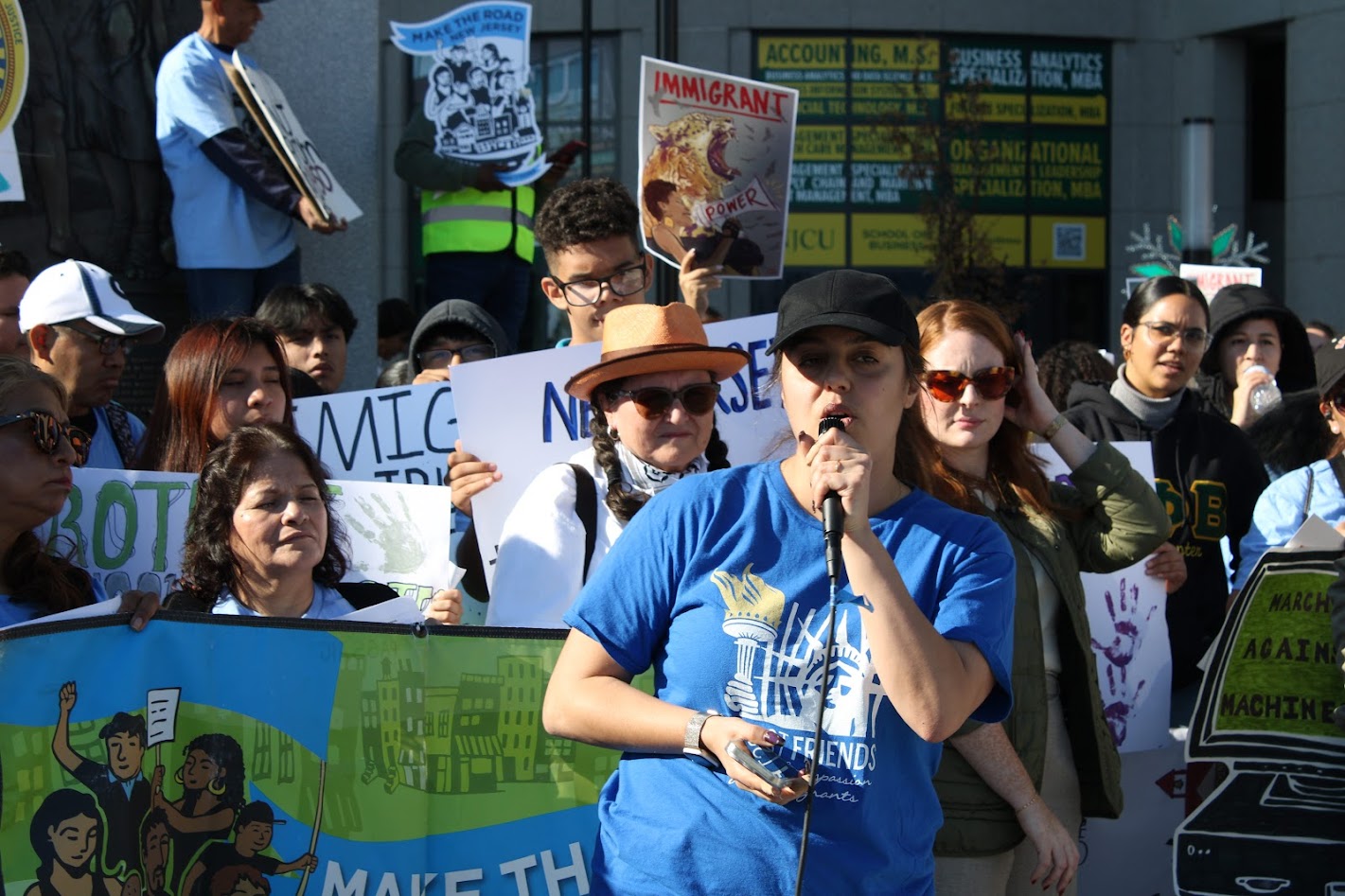
Katy Sastre: Being in community with other women, with queer people, non-binary folks, gender nonconforming people – this is what has shaped my work the most.
The truth is that in movement spaces, the people most relied on to hold everything together are often also the people who are most underestimated and most marginalized. I'm also incredibly shaped by Black feminism, which has taught me to start with the people who are most marginalized and build from there, so you're not thinking about those who are most legible to systems of power, or most comfortable, or most visible, but rather what everybody needs – starting from the most marginalized person – to feel safe and have dignity.
To me, that's completely inseparable from immigrant justice, because the same forces that harm immigrant communities are connected to racism, gendered violence, and all of the systems in this country that decide whose lives matter and whose don't – so our response has to be interconnected too.
Haliema Twam: Over the last decade of my career, I can say honestly that these last two years have been some of the most inspiring – having worked with such strong, intelligent, motivating, inspiring, fierce, and funny women, all in immigrant spaces, leading at different capacities, whether they're executive directors, organizers, educators, or board members. Together, we've been able to make some really big cultural and political shifts within our movements.
One of the things that I am always so excited to highlight is the way in which PACC is decolonizing, deinstitutionalizing, and really living up to its values in our vision. We have a primarily female staff, and all of the women here bring their children to the center – I mean, even right after maternity leave – bringing their young ones here to be in community, rather than having to be separated from them and spending time away from them when they're still so young. It's really a model that I hope many institutions, especially those in social justice spaces who are doing this work, will adopt. It's been truly a privilege to see that as a woman, we don't have to choose between our passions, our career, and our family.
It's also been really inspiring to see how in all of these spaces, we are pushing back on the misogyny that is very much embedded in so many of our cultures through our undeniable ability to get the jobs done.
So something that I would say in terms of advice is to keep creating the environment that you want to live in and working together with empathy and understanding. Don’t be afraid to organize within your own organization and movement, so that we can continue to create spaces that are humane – that are less about commodifying our time and energy and more about fulfilling ourselves in the work that we do.
Kimberly Valle: As a woman and daughter of immigrants, my leadership is shaped by lived experiences of navigating systems that were not always designed for people like me. Gender has strengthened my commitment to lead with empathy, collaboration, and community-centered approaches as I advocate for immigrant students and families whose voices are often overlooked.
Women, especially immigrant women of color, often form the backbone of families and communities, advocating for education, stability, and opportunity. Empowering women strengthens immigrant justice movements because when women have access to resources, leadership opportunities, and education, entire communities benefit.
Stay rooted in your story and the communities you serve, because lived experience is a powerful form of expertise. Build strong support networks, seek mentorship, and remember that your voice and leadership are essential to shaping more equitable systems.
Do you like this page?